“Now that I’m over 30, is it too late for braces?”
This is one of the most common questions adult patients in Bursa and Nilüfer ask during their orthodontic consultation.
Short answer: No, you’re not too late.
Adult orthodontics has grown massively both worldwide and in our country. As smile aesthetics have become more important in business life, social media, and daily interactions, getting braces after 30 is now completely normal and very common.
While searching for “adult braces Bursa,” you might be wondering:
In this guide, we’ll go through the most common orthodontic problems seen after the 20s, how adult treatment differs from teenage treatment, modern solutions like aesthetic brackets and Invisalign, and how the adult orthodontic process works specifically in the Bursa / Nilüfer area.
When we think of braces, most of us picture teenagers. But in real orthodontic clinics, the number of patients aged 25–45 is increasing every year. Adult patients usually come in with these concerns:
“My front teeth used to be straighter, but over the last few years they started overlapping.”
“My lower front teeth have started to rotate; brushing them is getting harder.”
This is the single most common situation in patients who want braces after 30. Over time, teeth shift slightly and crowding—especially in the lower front region—increases. This doesn’t just affect appearance; it also increases the risk of tartar build-up, cavities, and gum problems.
“Gaps opened between my front teeth; they’re very noticeable when I talk.”
“I didn’t have this as a child; it appeared as I got older.”
Gum recession, tooth loss, or periodontal disease can cause gaps between teeth in adulthood. Adult orthodontic treatment can close these spaces in a controlled way.
“My front teeth don’t fully touch; I have trouble biting.”
“I can hardly see my lower teeth, the uppers completely cover them.”
Functional problems can affect chewing and the jaw joint (TMJ). These conditions can be addressed with aesthetic orthodontics in a way that improves both appearance and function.
“I had braces when I was younger but didn’t wear my retainer regularly, so my teeth moved back again.”
In this group, treatment is often faster and more predictable—but the retention (retainer) phase must be taken very seriously.
“I want to replace missing teeth with implants, but I was told my teeth need to be aligned first.”
In Bursa and the surrounding area, adult braces are used not only for aesthetics but also to create ideal conditions for implants and bridgework.
In children and teens, bone is more flexible and responds more quickly to orthodontic forces. So what changes in adults?
After age 30, bone becomes more compact. This does not mean teeth cannot move; it simply means that movement must be more controlled, slower, and biologically gentle. In adult orthodontics, forces are lighter and planning is more detailed.
Adults often present with mild gum recession, bone loss, and chronic gum inflammation.
Over the years, extracted teeth, tilted neighbors, and leaning bridge abutments can make the situation more complex. The orthodontist doesn’t just “straighten crooked teeth”—they also:
In patients who already have implants, those implants have fused to the bone and become fixed anchor points.
For all these reasons, adult orthodontic planning must consider implant history and future prosthetic needs together.
“Okay, I understand braces are possible after 30. But I’m in business life; I can’t walk around with obvious metal braces…”
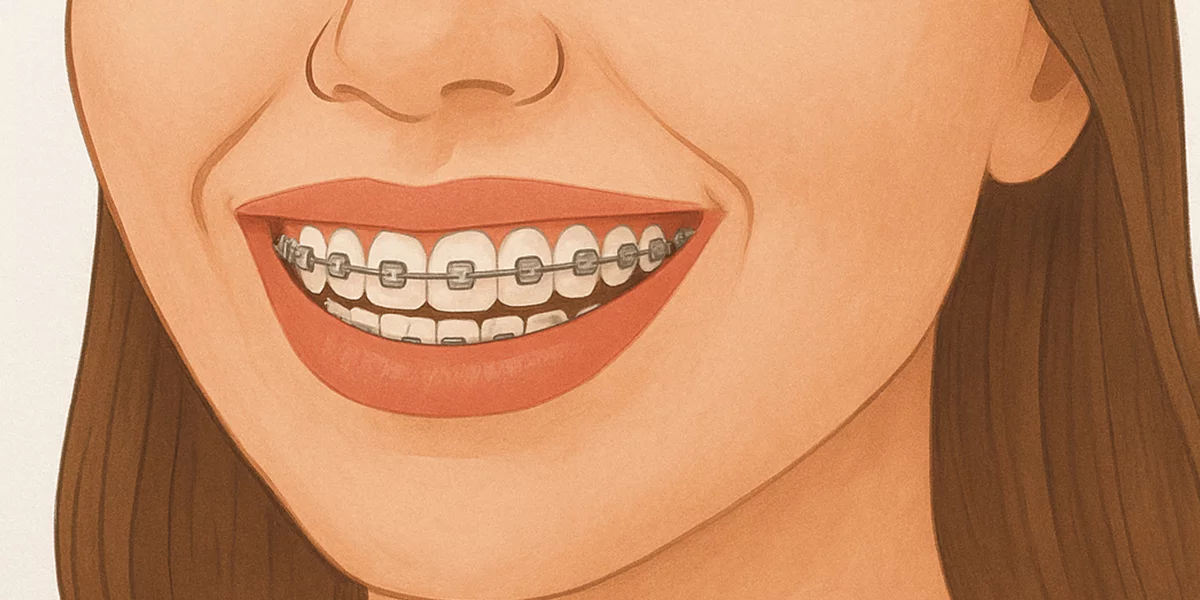
This is exactly where aesthetic orthodontics comes in. When you search “aesthetic orthodontics Nilüfer,” you’ll find modern options such as:
The right answer depends on:
The best method is chosen after an in-person examination and detailed analysis—not just from photos or messages.
In some adults, the problem is not only tooth alignment but also the position of the jaws themselves. For example:
In these cases, braces alone are not enough. Orthodontics is combined with orthognathic surgery (jaw surgery).
Typical sequence:
This is not necessary for every adult. But if you feel that “even if my teeth were straight, my facial profile wouldn’t look right,” a combined plan may be indicated. The key is choosing the right team and clinic from the beginning.
If you’re considering adult braces in Bursa, the process may feel overwhelming. In a well-organized clinic, however, the steps are clear, predictable, and comfortable.
“My front teeth are crowded; I feel uncomfortable when I smile in photos.”
Depending on the chosen approach:
You will be educated on:
When your teeth reach the planned positions:
In adult patients, the retention phase is absolutely critical.
A few months of neglect can compromise years of effort—
so wearing your retainer is just as important as the treatment itself.
The biggest concern for adults considering braces after 30 is:
“What will happen to my professional and social image?”
Here are some tips to help you get through adult orthodontic treatment more comfortably:
Adult orthodontics is very common now; many people start braces in their 30s or 40s.
Instead of seeing it as something to hide, think of it as an investment in yourself and your health.
To sum up:
If you look in the mirror and feel unhappy with your tooth alignment, or if you avoid smiling in meetings and photos,
maybe it’s not “too late”—
maybe it’s exactly the right time to invest in yourself.
With an orthodontic consultation in Bursa / Nilüfer, you can learn the exact status of your teeth, review the adult orthodontic options that fit you best, and make a fresh start for your smile.
Sensitive teeth and enamel erosion: How to protect your tooth structure every day. Discover the causes of tooth sensitivity, ways to prevent enamel erosion, and the effectiveness of desensitizing toothpaste and protective dental treatments.
A guide for Dutch patients on planning a smooth dental trip to Turkey for smile design treatments.
Discover why a well-designed smile has a powerful impact on how others perceive you.

Milim Dental Hospital isn't just a clinic—it's where confident smiles begin. With a team of world-class specialists, advanced technology, and a patient-first approach, we turn dental care into a premium experience.
We prioritize hygiene, comfort, and tailor-made treatments designed just for you. Don’t just take our word for it—explore real stories from real patients.
Your perfect smile starts here. Join the Milim experience.

Milim Dental Hospital provides comprehensive dental services in a spacious 1,000 m² facility, supported by a wide team of dental professionals including specialists in Oral and Maxillofacial Surgery, Prosthodontics, Orthodontics, Pediatric Dentistry, and Periodontology.