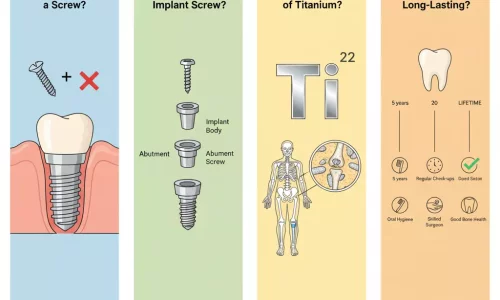
Is a dental implant a screw or is it made of titanium? What is an implant screw? How long do implants last? Learn about the biocompatibility and osseointegration process that ensures the long-term success of dental implants.
One of the most common and anxiety-provoking questions patients ask before seeing a dentist is exactly this. Especially when it comes to difficult extractions, wisdom tooth surgery, or long procedures, worries like “If I open my mouth too wide, can my jaw dislocate?” or “Can my jaw lock during tooth extraction?” are very common.

Wisdom teeth (third molars) do not behave the same way in everyone. In some people, they erupt fully and remain problem-free for life; in others, they stay partially impacted, causing food impaction, bacterial accumulation, recurring infections (pericoronitis), or decay on the neighboring tooth. Some remain completely impacted in the bone, “silent” yet potentially risky.

For years, you may have had to rely on denture adhesives such as Fixodent or Corega, feeling insecure while speaking, eating, or when your denture moved. Perhaps you were once told, “Implants are not possible,” or “Your bone loss is too severe.” Today, thanks to zygomatic implants, selected patients with advanced upper jaw bone loss can achieve a stable, adhesive-free, fixed solution.

Severe bone loss in the upper jaw is common in long-term denture wearers or patients with untreated gum disease. Normally, implant-supported teeth need solid bone to anchor into—something missing in many of these patients.

When it comes to restoring your smile with dental crowns, two of the most popular materials are Zirconia and E-Max. Both offer strength, aesthetics, and durability, but patients often ask: "Why is Zirconia more affordable than E-Max?"


Milim Dental Hospital provides comprehensive dental services in a spacious 1,000 m² facility, supported by a wide team of dental professionals including specialists in Oral and Maxillofacial Surgery, Prosthodontics, Orthodontics, Pediatric Dentistry, and Periodontology.